# micro-gopt
A go hand-reimplementation of .
Original python is included in the repo for reference against bitrot.
To use: `go run cmd/main.go input.txt`
Differences between the Go and the Python, as well as notes more generally:
- The GPT is implemented as a package and, separately, as a command-line wrapper that calls it, just to keep the algorithm separate from the invocation details.
- The Value class is more type-safe in go, using values everywhere as opposed to mingling floats and values in the localgrad tuple.
- The Value struct has actual tests confirming the backward propagation logic.
- When writing the Value struct and its methods, I accidentally swapped the order of the values in the `localGrads` slice in `Mul` and tore my hair out trying to figure out where the bug was. When I broke down and asked copilot to "compare these two implementations and tell me how they differ," it managed to find the error -- but also reported three non-existent differences and told me that `slices.Backward()` doesn't exist.
- Initial pass translating the linear algebra functions has me worried that all those value structs aren't going to be very fast...
- Had to implement weighted random choice. made that relatively straightforward; it's a neat algorithm.
First proper run:
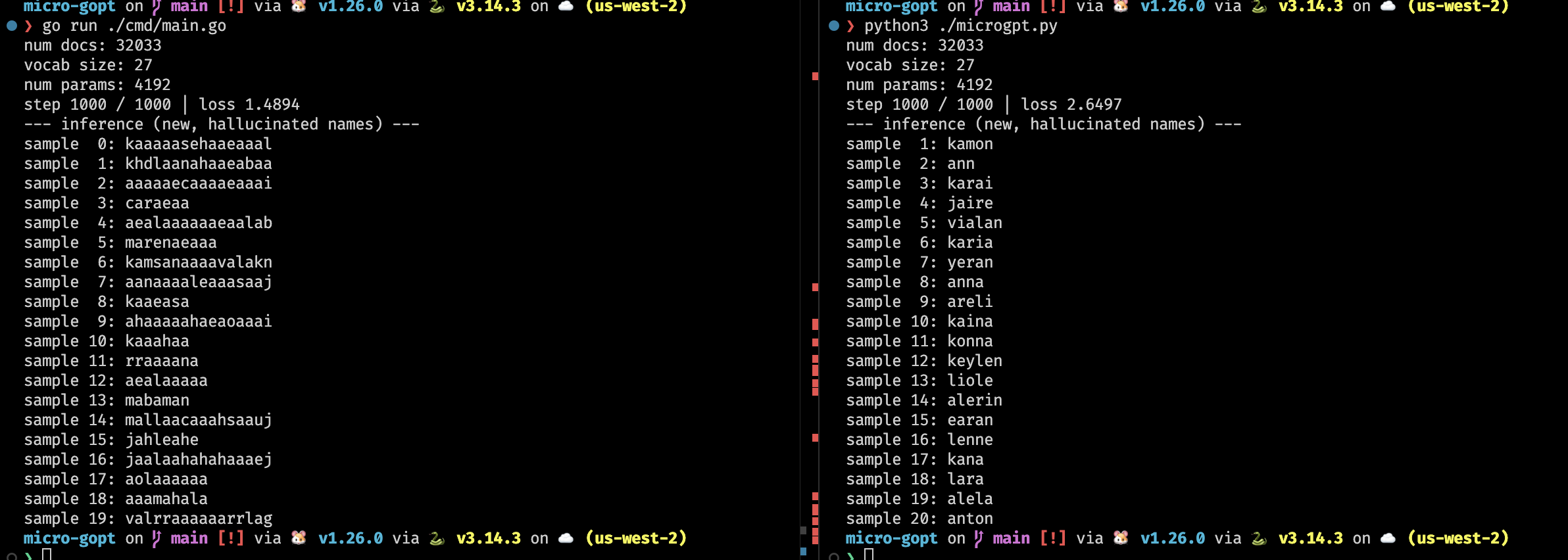
Something's not right here, unless the hit new baby name is `kaaaaasehaaeaaal`.
...
After a few more rounds of debugging, I'm stumped. There must be some subtle pythonic behavior that my rewrite isn't capturing that's causing my results to all be nonsense like `eadaaaaannnaanba` and `oetlaaceta`, but I can't see it (and I don't know enough python to find it).
This was still a useful learning opportunity, although a frustrating one in the end.
## Update September 2026
I asked Claude the same question I asked Copilot six months ago and after thinking for a bit, it pointed out two places where the go program's reference semantics were different than python's. With those two things fixed:
```plaintext
❯ go run cmd/main.go input.txt
num docs: 32033
vocab size: 27
num params: 4192
step 10000 / 10000 | loss 2.6872
--- inference (new, hallucinated names) ---
sample 1: breya
sample 2: kariste
sample 3: kari
sample 4: elyna
sample 5: aliann
sample 6: alayn
sample 7: asari
sample 8: amara
sample 9: kadili
sample 10: avan
sample 11: aarie
sample 12: amari
sample 13: keli
sample 14: kericy
sample 15: areta
sample 16: kailyn
sample 17: kona
sample 18: daley
sample 19: avile
sample 20: alion
```
Success.